
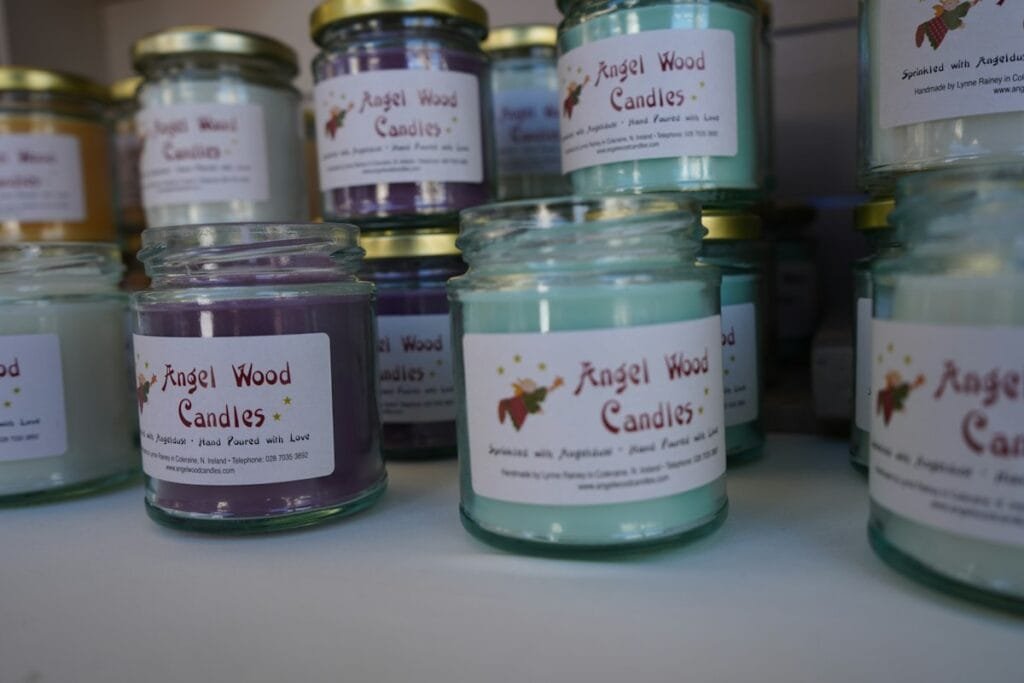
Quick answer: Whether Etsy or a craft fair leaves more money for a candle maker depends on your selling price, postage, marketplace fees, event expenses, how many candles you actually sell, and how much time you spend preparing and working the event. A craft fair may save shipping costs but add a booth fee and an entire day of work. Compare both channels with the same per-candle numbers before committing more inventory.
Suppose you make scented candles for gifts and home decor. Your product photographs look good, and you’ve been invited to a local makers market. Should you build more Etsy listings or book the next booth? Neither option wins automatically. The useful question is: How much is left after the costs of making and selling through each channel?
A $28 handmade candle: two selling channels
We’ll use one hypothetical candle priced at $28 USD. Assume wax, jar, wick, fragrance, warning label, and basic packaging together cost $8 per candle. We reserve $6 for production labor using an illustrative 20-minute process at $18/hour. Those are demonstration inputs, not published average candle costs or an appropriate wage for everyone.
For the Etsy example, assume a U.S.-based Etsy Payments seller, no separately charged shipping, no sales tax in the example, and seller-funded postage of $5.50. Based on Etsy’s published fee rules, the $28 item incurs a 6.5% transaction fee of $1.82; the U.S. payment processing example is 3% + $0.25, or $1.09; and a $0.20 listing fee is included. The example excludes Offsite Ads, optional ads, regulatory fees, refunds, currency conversion and other situational charges. Check Etsy’s full fee guide and processing fee table before applying this to your business.
For the craft fair, assume you sell 20 candles, have combined booth and travel expenses of $100, and accept cards at a hypothetical $1.09 processing cost per transaction. We allocate the $100 event expense across the 20 units sold: $5 per candle. Separately, we will account for the time needed to set up and run the booth.
| Hypothetical cost per candle | Etsy order | Craft fair, 20 sold |
|---|---|---|
| Sale price | $28.00 | $28.00 |
| Wax, jar, materials and packaging | −$8.00 | −$8.00 |
| Seller-paid postage | −$5.50 | $0.00 |
| Marketplace transaction fee | −$1.82 | $0.00 |
| Payment processing (Etsy actual example / market assumed) | −$1.09 | −$1.09 |
| Etsy listing fee | −$0.20 | $0.00 |
| Share of booth and travel costs | $0.00 | −$5.00 |
| Amount remaining before labor and overhead | $11.39 | $13.91 |
Looking only at the costs above, the craft fair leaves $2.52 more per candle. But that is not the full comparison. It treats a busy day at the booth as though your time were free.
The overlooked craft-fair expense: your entire day
Assume the market and preparation use eight hours in total: travel, setup, selling, and packing down. At a hypothetical allowance of $15 per hour, you want the event to cover $120 of that time. At 20 sales, that is another $6 per candle, in addition to the $6 reserved for making each candle. At those assumptions:
| Cost stage | Etsy | Craft fair |
|---|---|---|
| Before labor | $11.39 | $13.91 |
| Reserve candle-making labor | −$6.00 | −$6.00 |
| Allocate event work time | Not applicable | −$6.00 |
| Amount remaining after these allowances | $5.39 | $1.91 |
The apparent winner has changed. That’s why we shouldn’t decide using one attractive revenue figure. The right channel also depends on whether your time at a fair generates useful exposure, repeat orders, or local relationships that you can actually measure.
What happens if the craft fair is quiet?
Event expenses are risky because they are largely fixed before anyone buys a candle. In this example, materials cost $8, card processing costs $1.09, and production labor allowance costs $6 per sale. That leaves $12.91 per candle to cover the event’s $100 fee-and-travel budget and the $120 allowance for running the event.
Event contribution after the chosen allowances = number of candles sold × $12.91 − $220.
| Candles sold | Sales revenue | Amount left after included materials, card fees, production labor, event expenses and event-time allowance |
|---|---|---|
| 10 sold | $280.00 | −$90.90 |
| 20 sold | $560.00 | $38.20 |
| 35 sold | $980.00 | $231.85 |
You would need to sell at least 18 candles in this simplified scenario to cover those included event and labor allowances. Selling ten leaves a shortfall despite $280 collected from shoppers. Selling 35 creates more room, but only if you can make enough stock and find that many buyers. Never use a best-case sales number as your only plan.
Etsy isn’t free of hidden work, either
An online candle order may need product photography, listing work, customer messages, careful shipping protection, address checks, refunds and replacements for damaged parcels. In our table, we included one seller-paid postage amount but not those extra hours. Etsy can also have advertising-related or region-specific fees. That makes the $5.39 after production labor an incomplete contribution estimate, not take-home pay.
Check whether buyers pay for postage separately, whether transaction and payment fees apply to that shipping amount, and whether your actual postage costs fluctuate by distance. If your candles are fragile or heavy, packing and shipping may become more important than the marketplace’s basic transaction percentage.
Five questions candle makers should answer before picking a channel
- How many candles will I realistically sell? Use records from comparable events, not the organizer’s crowd estimate alone.
- What does each unit really cost? Include wax, fragrance, wick, container, label, boxes, rejects, and any materials consumed by testing.
- How much working time does each channel require? Measure production and channel-specific work separately.
- What happens to unsold seasonal stock? Count cash tied up in inventory and any products you might not be able to sell later.
- What rules apply? Check local market permits, insurance, product and fire-safety requirements, labeling, taxes and online shipping rules. Requirements vary, so do not treat this pricing exercise as a compliance checklist.
Use the right PrimeSelfPath tool for the decision
For a quick candle-level calculation, enter the price, materials and selling fees into our free Profit Check. It runs in your browser without signup and estimates the amount left after the costs you enter. It does not automatically subtract labor wages, overhead or taxes.
For comparing several candle products and reviewing recorded sales, Business Profit Check ($9, one-time) is a focused tool for comparing selling prices, direct costs, and sales. It is not integrated with Etsy or automatic accounting software. Enter relevant channel costs yourself.
For an in-person selling event, Market Day ($9, one-time) helps track products, recorded event sales, booth and travel costs, estimated profit, and sell-through. It helps you compare what actually happened with what you planned, while you remain responsible for checking labor and overhead.
Related reading: Was This Craft Fair Worth It?, How Much Inventory to Bring to a Holiday Craft Fair, What a $30 Etsy Sale Leaves After Costs, and Should Handmade Sellers Offer Black Friday Discounts?.
The practical decision
Before booking a booth or offering free shipping, choose the same candle, use the same production costs, and calculate two or three realistic sales scenarios for each channel. Protect your time and cash first. Then test the channel that can reasonably support your goals with the lowest risk, rather than choosing the one that appears to generate the most sales revenue.
All sample figures are hypothetical and do not represent real customer results, typical candle pricing or guaranteed demand. This content is educational, not financial, accounting, legal, or tax advice.