

Mental clutter often feels like having twenty browser tabs open in your head at once. A task, an unanswered message, something you are waiting for, a decision you have not made, and a few things you are afraid of forgetting can all stay mentally active at the same time.
You do not need to solve everything to feel clearer. You need to reduce how many things are asking for your attention right now.
What Mental Clutter Actually Looks Like
- You keep remembering small unfinished tasks at random moments.
- You are waiting on someone else, but the issue still feels active in your head.
- You have several decisions to make and none feels easy to start.
- You reopen lists, notes, messages, or tabs because you are worried you will forget something.
- You know you should focus on one thing, but everything keeps interrupting everything else.
This kind of mental clutter is not automatically a health problem. It can simply be the result of too many open loops competing for attention. If changes in thinking, concentration, memory, or decision-making are persistent, severe, sudden, or concerning, speak with a qualified health professional.
A gentle next step
If unfinished thoughts are part of the friction
Open Loop Rescue gives tasks, decisions, requests, and waiting items one private place to land so you can see what still needs you.
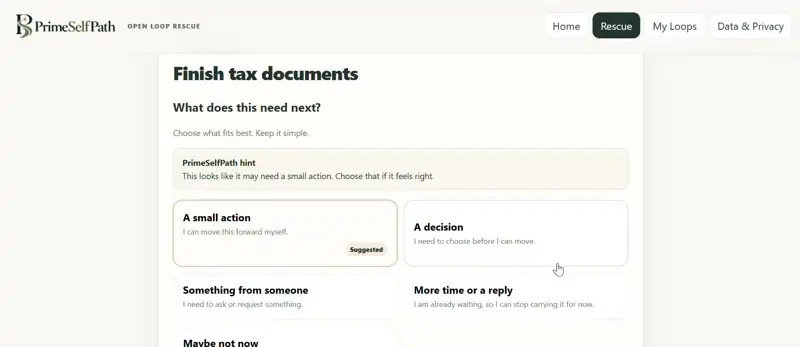
Real Open Loop Rescue screen · the tool helps turn a vague open loop into the kind of next move it actually needs.
See how Open Loop Rescue works →Why Unfinished Tasks Keep Feeling Mentally Active
An unfinished task does not need to be large to take up mental space. Sometimes the smallest unresolved item keeps resurfacing because your brain has not been given a clear answer about what happens next.
The same thing happens with waiting. If you sent an email and someone else now has the next move, the task may still feel like yours unless you deliberately mark it as waiting. A postponed decision can create the same friction. So can a project that is technically important but has no clear next action.
The goal is not to finish every unfinished task. It is to give each one a clearer state.
Use the Four-Bucket Mental Clutter Reset
Take a blank page or note and quickly capture what keeps resurfacing. Then move each item into one of four buckets.
1. Needs action
This is something you can actually move forward yourself. Do not write a vague project name if you can avoid it. Write the next visible action.
Instead of “taxes,” write “find the missing receipt.” Instead of “website,” write “rewrite the first paragraph of the homepage.”
2. Waiting
Someone or something else has the next move. Record what you are waiting for and when you will check again. Until then, it does not need to stay at the front of your attention.
If waiting items are the part that keeps pulling you back in, use this more specific guide on how to stop thinking about tasks you can’t act on yet.
3. Park for later
The item matters, but not now. Give it a future review point instead of repeatedly reconsidering it today.
4. Let go
Some mental clutter survives only because you have not consciously decided to stop carrying it. If the task no longer matters enough to earn your attention, remove it.
One Useful Note
Get the 3-question mental load reset.
A tiny reset for deciding what needs action, what can wait, and what can leave your attention. Then get occasional practical PrimeSelfPath notes, not daily noise.
Free · useful emails only · unsubscribe anytime.
Choose One Thing That Still Needs You
After sorting, do not immediately build another complicated plan. Look only at the items that genuinely need action from you.
If you are still unsure which one should come first, use the Decision Fatigue reset. It helps narrow several competing options into one useful next move.
A 10-Minute Mental Clutter Reset
- 3 minutes: write down everything that keeps resurfacing.
- 3 minutes: label each item Action, Waiting, Park, or Let Go.
- 2 minutes: rewrite the most important Action item as one concrete next step.
- 2 minutes: begin that step before reopening the full list.
The reset works because it changes the question from “How do I handle everything?” to “What actually needs me now?”
What Not to Do When Your Mind Feels Full
- Do not keep adding more planning layers unless they remove decisions.
- Do not treat waiting as if it requires constant attention.
- Do not keep every possible future task in today’s active list.
- Do not confuse remembering something with needing to act on it immediately.
If simplifying routines is a recurring need, the broader Minimalist Wellness guide shows how to reduce friction without turning your life into another system to manage.
When a Normal To-Do List Is Not Enough
If writing everything down has started to create another wall of unfinished items, see Mental Load vs To-Do List for the difference between capturing a task and deciding whether it still deserves active attention.
A to-do list is useful when the problem is remembering tasks. It is less useful when the real problem is that tasks, decisions, requests, waiting items, and future possibilities are all mixed together.
Open Loop Rescue is built for that specific situation. It helps you unload unfinished things, separate what needs action from what can safely wait, and identify one clear next move without creating another giant productivity system.
Frequently Asked Questions
How do I clear mental clutter quickly?
Capture what keeps resurfacing, then separate it into Action, Waiting, Park, and Let Go. The fastest relief usually comes from reducing the number of items that still require active attention.
Why do unfinished tasks stay in my head?
Unfinished tasks often remain mentally active when the next step, owner, or review point is unclear. Giving the item a defined state can reduce the need to keep mentally checking it.
What if everything feels important?
Separate what actually needs action from what is waiting, optional, or future. If several action items still compete, use a decision filter based on urgency, consequences, blockers, and what fits your available time.
A practical next step
Need a clearer next move?
Open Loop Rescue is PrimeSelfPath’s private tool for unloading unfinished thoughts, separating what needs action from what can wait, and choosing one clear next move.

Real product screen · the goal is not a longer list. It is fewer things asking for space.
Explore Open Loop Rescue · $19One-time purchase · no subscription
PrimeSelfPath content is educational and is not medical or mental-health advice, diagnosis, or treatment.
