

A to-do list is useful when the problem is forgetting. It is less useful when the real problem is that too many different kinds of unfinished things are all wearing the same checkbox.
Tasks you can act on, decisions you have not made, replies you are waiting for, requests you need to send, ideas you may never pursue, and things you should probably let go can all end up in one long list. Once that happens, the list may be accurate without actually making your mind feel lighter.
A To-Do List Records. Mental-Load Sorting Resolves.
Writing something down can help because you no longer have to rely on memory alone. But capture is only the first step. After the item leaves your head, one question still remains: what does this actually need from me?
That is the difference between a normal task list and a mental-load map. A task list says what exists. A mental-load map separates what needs action now from what is waiting, undecided, optional, blocked, or no longer worth carrying.
A gentle next step
If unfinished thoughts are part of the friction
Open Loop Rescue gives tasks, decisions, requests, and waiting items one private place to land so you can see what still needs you.
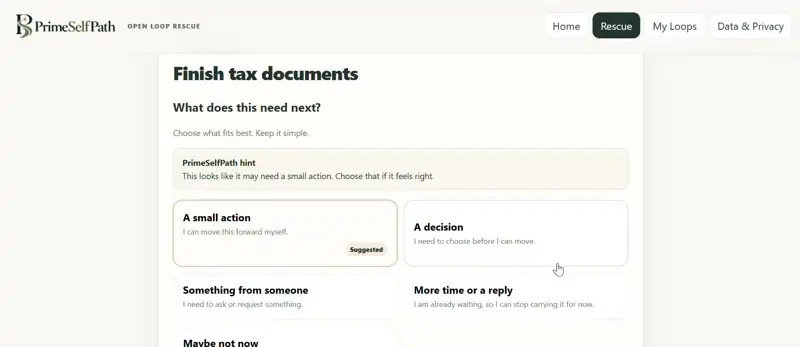
Real Open Loop Rescue screen · the tool helps turn a vague open loop into the kind of next move it actually needs.
See how Open Loop Rescue works →Why One Giant List Can Start Feeling Heavy
Imagine these five items sitting next to each other:
- Finish tax documents
- Waiting for refund
- Decide whether to cancel a subscription
- Ask insurance about the missing reply
- Maybe redesign the spare room someday
They are not the same kind of thing, but a standard checklist can make them look equally unfinished. That matters because each one creates a different demand on your attention.
- Finish tax documents needs action.
- Waiting for refund may need nothing until a review date.
- Cancel or keep the subscription needs a decision.
- Ask insurance needs a request.
- Redesign the spare room may belong in a future parking area, not today’s active list.
The weight is not always the number of items. Sometimes it is the fact that your system does not tell you which items still deserve active attention.
The Six States That Make a List More Useful
1. Action
You can move this forward yourself. Give it a concrete next step instead of leaving it as a broad project label.
2. Waiting
Someone or something else has the next move. Record what you are waiting for and when you will check again. Until then, it does not need to compete with today’s action items.
3. Decision
The item is not a task yet. It first needs a choice. Treating decisions as ordinary tasks can make a list feel strangely sticky because there is no obvious physical action to begin.
4. Request
You need information, approval, help, or a response from someone else. The next move is often simply to send the request.
5. Park
This matters, but not now. Give it a future review point so it can stop appearing beside today’s work.
6. Let Go
Some captured items are possibilities, not commitments. If something no longer deserves your time or attention, removing it can be more useful than carrying it forward for another month.
One Useful Note
Get the 3-question mental load reset.
A tiny reset for deciding what needs action, what can wait, and what can leave your attention. Then get occasional practical PrimeSelfPath notes, not daily noise.
Free · useful emails only · unsubscribe anytime.
A Simple Mental-Load Reset for an Overgrown To-Do List
- Capture: write down what keeps resurfacing without trying to organize it perfectly.
- Label: mark each item Action, Waiting, Decision, Request, Park, or Let Go.
- Quiet: move Waiting and Park items out of the main active view.
- Clarify: turn the most important Action item into one visible next step.
- Begin: start that step before reorganizing the entire system again.
If you first need to reduce a crowded field of unfinished thoughts, start with How to Clear Mental Clutter. If the harder problem is that you cannot act on something yet, use How to Stop Thinking About Tasks You Can’t Act on Yet.
When a To-Do List Is Still the Right Tool
A simple to-do list is still excellent when the work is already clear. If you know what needs doing, the tasks are actionable, and the list does not create pressure by itself, there is no reason to build a more complicated system.
The goal is not to replace every list. It is to notice when the list has stopped answering the real question.
The useful question is not only “What is unfinished?” It is “What still needs me?”
What If Everything Still Feels Equally Important?
Once you remove waiting, parked, and irrelevant items, you may still have several actions competing for attention. That is a prioritization problem, not a capture problem.
Use the Decision Fatigue reset to narrow the field by urgency, consequences, blockers, and what fits the time and energy you actually have.
When You Want the Sorting Done in One Place
Open Loop Rescue is built around this exact distinction. Instead of treating every open loop as another checkbox, it helps separate action, waiting, decisions, requests, parking, and letting go, then surfaces one clear next move.
It is not meant to replace calendars, team project-management tools, or every task system. It is for the moments when too many different kinds of unfinished things are all competing for the same mental space.
Frequently Asked Questions
Does writing everything down reduce mental load?
It can help because you no longer need to rely on memory alone. But if captured items are left in one undifferentiated list, the list itself can still feel noisy. Sorting by what each item needs can make the capture more useful.
Why does my to-do list make me feel more overwhelmed?
One reason is that action items, waiting points, decisions, optional ideas, and future tasks may all look equally unfinished. Moving non-action items out of the active field can make the list easier to use.
Should I delete tasks I keep postponing?
Sometimes. First decide whether the task is truly a commitment, something to park for later, or a possibility you no longer want. Repeated postponement can be useful information.
A practical next step
Need a clearer next move?
Open Loop Rescue is PrimeSelfPath’s private tool for unloading unfinished thoughts, separating what needs action from what can wait, and choosing one clear next move.
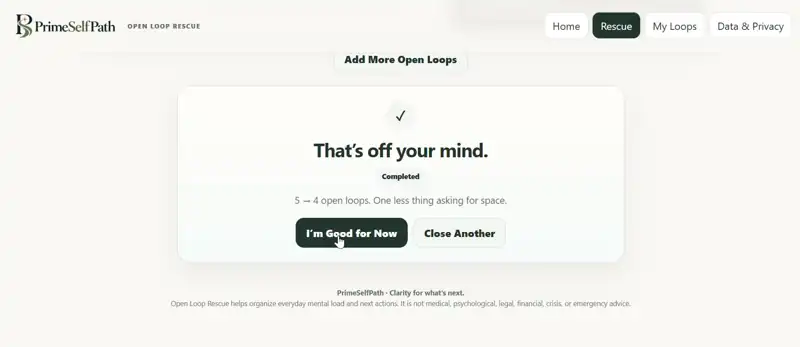
Real product screen · the goal is not a longer list. It is fewer things asking for space.
Explore Open Loop Rescue · $19One-time purchase · no subscription
PrimeSelfPath content is educational and is not medical or mental-health advice, diagnosis, or treatment.
