

If you feel overwhelmed and do not know where to start, do not try to rank your entire life at once. Reduce the field. Identify anything genuinely time-sensitive, choose the smallest action that reduces uncertainty, and begin that action for five minutes.
That is the core of this decision fatigue reset: fewer choices between you and one useful move.
Decision fatigue often looks ordinary. You reopen the task list, switch priorities, check another tab, and somehow still do not begin. When your attention is already overloaded, adding a more sophisticated planning system can create another decision instead of solving the first one.
What Decision Fatigue Feels Like in Everyday Life
- You keep reorganizing the list instead of doing an item on it.
- Several tasks feel equally urgent, so none becomes the obvious starting point.
- You switch to easy distractions because choosing feels harder than scrolling.
- You spend more energy deciding how to work than actually working.
- You know there are useful things you could do, but cannot tell which one deserves attention first.
This article is about ordinary decision overload, not a medical diagnosis. If difficulty thinking, concentrating, or making decisions is persistent, sudden, severe, or concerning, treat it as a health question and speak with a qualified professional.
A gentle next step
If unfinished thoughts are part of the friction
Open Loop Rescue gives tasks, decisions, requests, and waiting items one private place to land so you can see what still needs you.
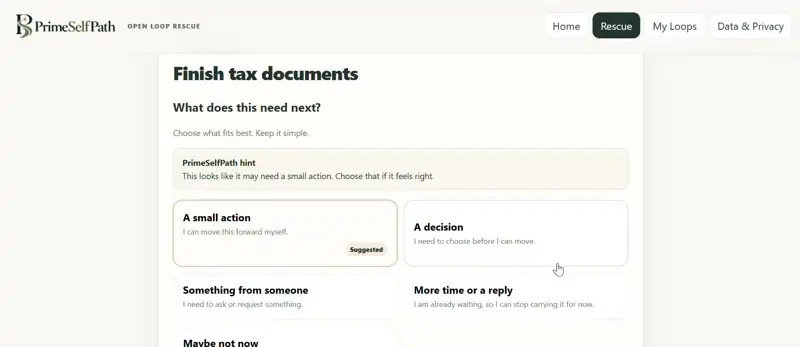
Real Open Loop Rescue screen · the tool helps turn a vague open loop into the kind of next move it actually needs.
See how Open Loop Rescue works →Why Mental Clutter Builds Around Unfinished Tasks
Mental clutter is not always caused by having too much to do. Often, it grows because too many unfinished tasks, unanswered questions, waiting points, and half-made decisions are all competing for the same attention.
A task you cannot act on yet can still feel mentally active. So can a message you are waiting for, a decision you keep postponing, or a project with no clear next step. When everything stays open at once, your brain keeps rechecking the same loops instead of settling into one useful action.
If the hardest part is the items that are genuinely out of your hands for now, use How to Stop Thinking About Tasks You Can’t Act on Yet.
The goal is not to force every open loop to completion. It is to decide which unfinished things need action now, which are waiting on someone else, which can be parked, and which can safely be dropped. If you first need help sorting that noise, use How to Clear Mental Clutter. If the open loops themselves are the problem, Open Loop Rescue is designed specifically for that kind of mental load.
Overwhelmed and Don’t Know Where to Start? Use This 60-Second Triage
Before you plan anything, run the list through three fast filters.
1. What is actually time-sensitive?
Separate genuine deadlines, appointments, consequences, and blockers from tasks that simply feel loud. If something must happen today or another person cannot move forward until you act, keep it in the smaller decision set.
2. What would reduce the most uncertainty?
The best next action is often not the biggest task. It may be the small action that gives you information: send the question, confirm the appointment, open the document, check the requirement, or choose between two realistic options.
3. What fits the time and energy I actually have?
A 15-minute window and a low-energy afternoon are poor conditions for a two-hour deep-work task. Choose something useful that fits the real moment rather than the ideal version of your schedule.
If only one item survives all three filters, start there. If several survive, choose the one that removes the most uncertainty or unlocks another task.
One Useful Note
Get the 3-question mental load reset.
A tiny reset for deciding what needs action, what can wait, and what can leave your attention. Then get occasional practical PrimeSelfPath notes, not daily noise.
Free · useful emails only · unsubscribe anytime.
Turn the Choice Into One Good Move
Once you narrow the field, translate the task into a physical next action. The smaller and clearer the action, the less interpretation your brain has to do before starting.
| Vague task | One good move |
|---|---|
| Work on presentation | Open the deck and write the three slide headings |
| Handle finances | Open the latest statement and identify the first unpaid bill |
| Clean the house | Clear the kitchen counter for ten minutes |
| Catch up on email | Reply to the two messages blocking someone else |
| Plan the project | Write the next decision the project actually needs |
“Work on it” creates another decision. “Open it and do this first piece” gives you somewhere to put your hands.
The 10-Minute Decision Reset
- 2 minutes: capture every task competing for attention.
- 2 minutes: mark only genuine deadlines, blockers, and high-value items.
- 1 minute: choose one item that fits the time and energy available now.
- 5 minutes: begin the smallest concrete action before evaluating the plan again.
The point is not to finish everything in ten minutes. It is to cross the gap from choosing to doing.
If the real problem is that too many unfinished things are competing for attention, Open Loop Rescue helps you unload them, separate action from waiting, and identify one clear next move.
If Everything Feels Urgent
When everything is labelled urgent, the label stops helping. Ask what creates a real consequence if delayed. A bill due today, a meeting in an hour, or a reply blocking a coworker is different from a task you would simply prefer to finish soon.
If several tasks truly are urgent, choose the shortest action that prevents the largest immediate problem, then reassess. You do not need a perfect priority order before you can make progress.
Reduce Repeat Decisions With Defaults
If the same kind of choice keeps draining you, create a default instead of solving it from scratch every day.
- Keep one trusted place for captured tasks.
- Use a short default morning start list.
- Define what “enough for today” means before the evening.
- Create a default first action for recurring work, such as opening the file and writing three rough bullets.
This is part of the broader PrimeSelfPath idea of reducing friction rather than adding another system to maintain. See Minimalist Wellness: A Low-Friction Routine for Real Life.
Choose the Right Reset for the Problem
- If you cannot decide what deserves attention, stay with this decision reset.
- If you know what matters but your attention has scattered, use the 3-step afternoon reset.
- If the whole day has already gone off-track, use How to Restart a Bad Day Without Starting Over.
Frequently Asked Questions
What should I do first when I feel overwhelmed?
Do not begin by creating a perfect plan. First separate genuine deadlines and blockers from everything else. Then choose one small action that reduces uncertainty or prevents an immediate problem.
What if I have too many things to do and cannot prioritize?
Use constraints instead of trying to compare every task. Ask what is time-sensitive, what unlocks another task, and what fits the time and energy you have now. This shrinks the decision set.
What if I choose the wrong task?
For many ordinary tasks, a reasonable useful action is better than staying frozen while searching for the perfect one. Start small, learn from the first few minutes, and adjust if new information changes the priority.
You do not need certainty about the whole day. You need enough clarity to make the next useful move.
A practical next step
Need a clearer next move?
Open Loop Rescue is PrimeSelfPath’s private tool for unloading unfinished thoughts, separating what needs action from what can wait, and choosing one clear next move.
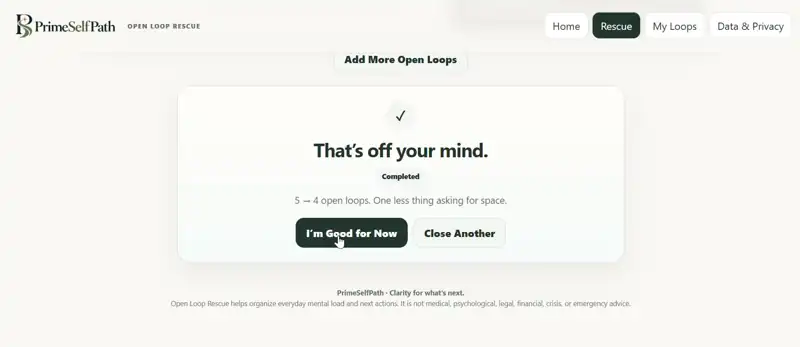
Real product screen · the goal is not a longer list. It is fewer things asking for space.
Explore Open Loop Rescue · $19One-time purchase · no subscription
PrimeSelfPath content is educational and is not medical or mental-health advice, diagnosis, or treatment.
